One time I had a woman call the nature center at nearly closing time because her son had discovered something “with a butt like a bald man’s head” in the porch railing. It was a carpenter bee, and after I explained the shiny black abdomen, she laughed and said, “That’s it.” That’s the kind of identification this guide is designed for: the detail that allows you to say, “yes, that’s it,” when you read it, rather than “yes, that could be it.
Table of Contents
The vast majority of bees you encounter in your North American yard belong to one of seven general categories. In the order people ask about them, here’s how to tell them apart.
Bee or Wasp? The Fast Answer
Bees are round, fuzzy, and muted in color- black, brown, gold, or striped- built to haul pollen home, so they often look a little chubby or hairy around the back legs. Wasps are sleeker and shinier, with a pinched waist and a smooth, almost polished body, because they’re built to hunt rather than gather. If it’s slow and rounded and clearly interested in a flower, it’s a bee. If it’s darting fast, shiny, and hanging around your soda can at a picnic, it’s probably a yellow jacket.
Honeybee (Apis mellifera)

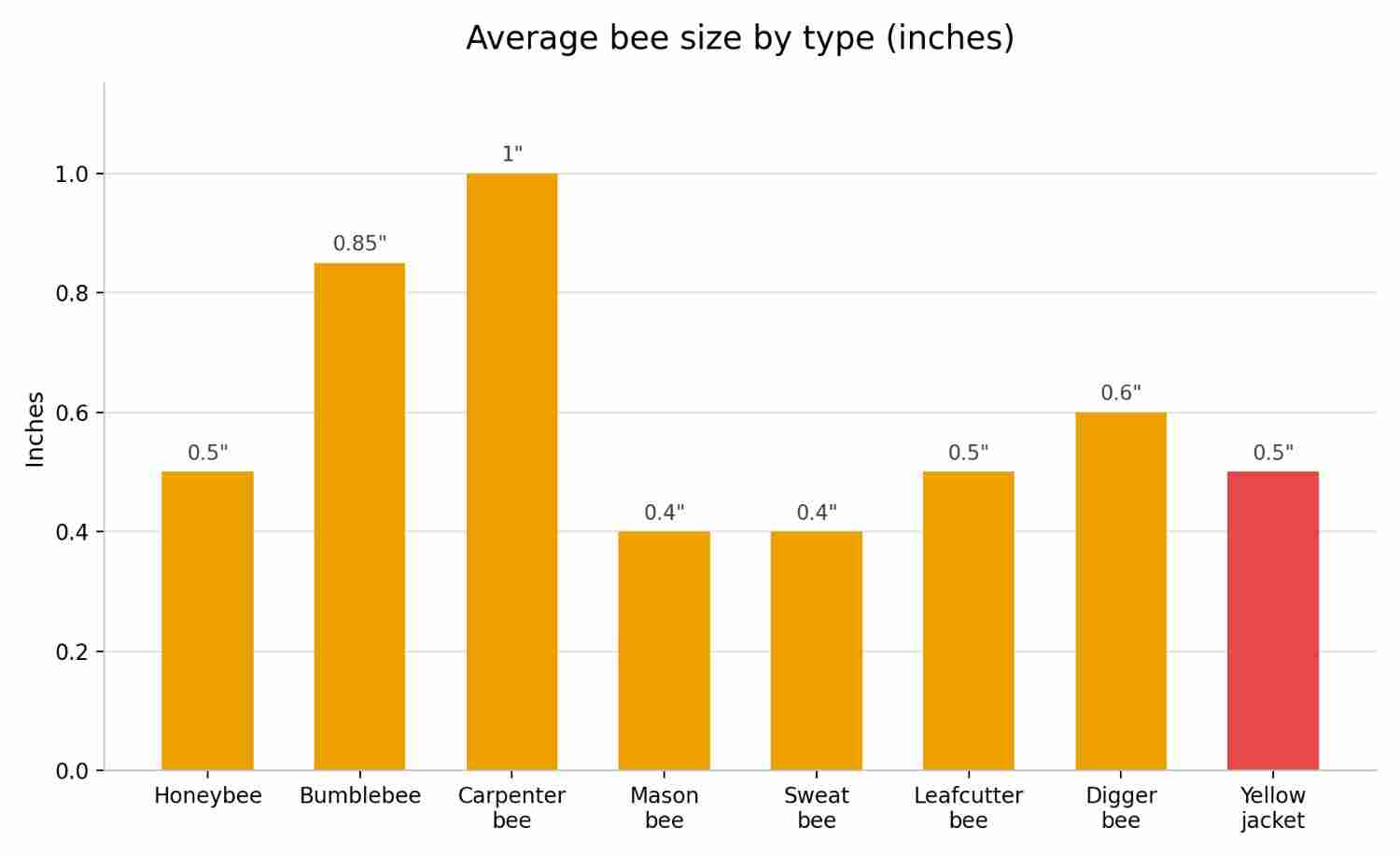
This is the one everyone pictures: small, about half an inch, with muted amber and black banding rather than the bright cartoon stripes people expect, and a noticeably fuzzy thorax that thins out toward the striped abdomen.
Is it dangerous? A honeybee’s stinger is barbed, so using it kills her, which means she has a strong biological reason to avoid stinging unless she’s actually being crushed or her hive is under attack. What you should watch for isn’t one bee on a flower; it’s a steady stream of them going in and out of one specific gap in a wall, chimney, or hollow tree. That pattern means there’s a colony established inside, and that’s worth a phone call.
What to do right now: One bee on a flower needs nothing from you. A hive inside a structure needs a local beekeeper, not a can of spray, since honeybee numbers have been dropping for years and a beekeeper can pull the colony out alive rather than kill it.
Bumblebee (Bombus species)
Big, round, and covered in dense hair from head to tail, bumblebees look almost too heavy for flight and fly anyway, with a slow, bumping style that’s easy to spot from across a garden. They run larger than honeybees, close to an inch on the biggest species, and the coloring is bold black and yellow, sometimes with orange mixed in.
Is it dangerous? Not really, and the reason isn’t mysterious; it’s colony math. A bumblebee colony is small, often just a few hundred bees living in an old rodent burrow or a pile of garden debris, and there’s no large hive worth dying to defend, so females rarely sting unless the nest itself gets stepped on or dug into.
What to do right now: If you find a small ground nest, just give it a wide berth for the six to eight weeks the colony stays active. It empties on its own by fall; no removal needed.
Carpenter Bee (Xylocopa species)
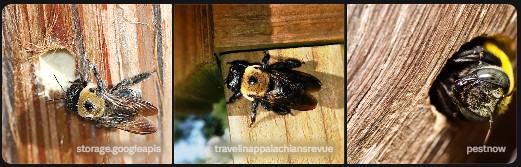
People mix these up with bumblebees constantly, and the fast way to tell them apart is the abdomen. Carpenter bees have a smooth, shiny, almost bald black abdomen, while a bumblebee is fuzzy all the way down. Carpenter bees also tend to hover stubbornly at eye level near wood eaves, deck rails, and fence posts, which is usually your first clue before you even see the abdomen clearly.
Is it dangerous? The males, the ones that dive-bomb your head near a porch, don’t have a stinger at all, they’re bluffing. Females can sting but seldom do unless you physically grab one. The real issue is the wood. Carpenter bees chew perfectly round, dime-sized holes to nest in, and the same wood gets reused and expanded year after year, which over time can genuinely weaken a deck rail or fascia board.
What to do right now: One or two bees hovering near the eaves need no action. Multiple round holes with sawdust piling up underneath are worth a call to pest control that specifically handles wood-boring insects.
Mason Bee (Osmia species)
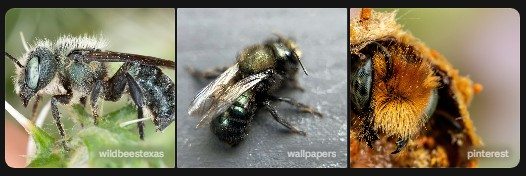
Small, often a striking metallic blue or dark green, and noticeably less fuzzy than a bumblebee, closer in build to a large housefly. They’re solitary: no queen, no hive; each female builds and provisions her own nest alone, sealing individual chambers with mud, which is where the name comes from.
Is it dangerous? Commercial orchards raise mason bees specifically because they can be handled in their nesting tubes without much fuss; that alone tells you how unlikely a sting is. They’ll only sting if pinched directly between fingers.
What to do right now: If they’re investigating small holes in a wall, a fence post, or a bee hotel, that’s exactly the behavior you’d expect, and it’s a sign your yard is doing something right for pollinators.
Sweat Bee (Family Halictidae)
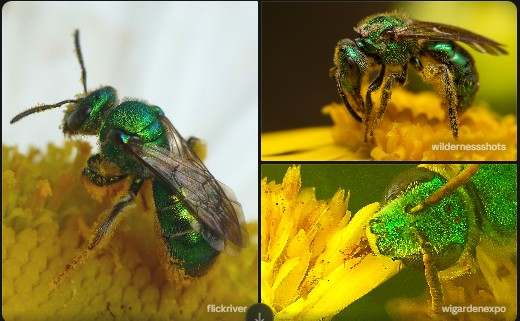
Tiny, often metallic green or blue, and named for an odd habit, they’ll land on bare skin to drink sweat, which catches people off guard the first time it happens. Most are under half an inch, and the metallic species are some of the most visually striking insects you’ll find in a yard.
Is it dangerous? If it stings at all, it’s mild, often milder than a honeybee’s. Most encounters end with the bee landing for a few seconds and moving on.
What to do right now: Brush it off gently rather than swatting. A swat is what actually provokes the sting; the landing itself rarely does.
Leafcutter Bee (Megachile species)

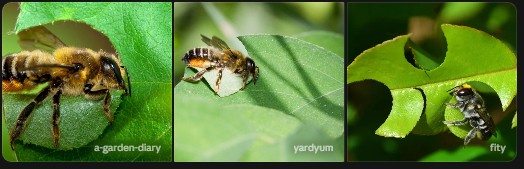
Roughly honeybee-sized, dark with pale banding across the abdomen, and the real giveaway isn’t the bee; it’s the damage: clean, almost surgical semicircles cut from the edges of rose leaves, redbud leaves, or other soft foliage. If your rose bush looks like someone took a hole punch to it overnight, that’s this bee, not a pest infestation.
Is it dangerous? No, and the leaf damage is cosmetic. This was one of the most common “what’s eating my plant” calls I got, and the answer was almost always this bee doing exactly what she’s supposed to do.
What to do right now: Nothing; the plant isn’t harmed.
Digger Bee (Anthophora and related genera)
Solitary ground nesters, often fuzzy enough to be mistaken for small bumblebees at a glance. The real tell is behavior: a cluster of small mounds or holes in a bare, sunny patch of soil or lawn, with bees hovering low and diving in and out. It looks like a swarm because of the sheer number of individuals, but it’s actually dozens of separate females, each nesting in her own burrow in the same patch of ground because the soil conditions suit them all.
Is it dangerous? Low risk. Each female is focused on her own nest, not defending shared territory, so they rarely sting even in a dense aggregation.
What to do right now: Leave the patch alone if you can; it’s usually active for just a few weeks in spring. If it’s somewhere high traffic like a play area, add mulch or grass seed to that bare soil once the season ends, since digger bees prefer exposed ground and won’t come back to a covered patch.
Quick Comparison Table
| Bee Type | Size | Key Feature | Nesting Style | Sting Risk |
| Honeybee | ~0.5 in | Amber and black stripes, fuzzy thorax | Hive colony | Low, dies after one sting |
| Bumblebee | Up to 1 in | Round, fuzzy all over, black and yellow | Small ground colony | Very low, docile |
| Carpenter Bee | ~1 in | Shiny bald black abdomen | Solitary, bores into wood | Very low, males can’t sting |
| Mason Bee | ~0.4 in | Metallic blue or green, slim | Solitary, mud sealed holes | Extremely low |
| Sweat Bee | Under 0.5 in | Bright metallic green or blue | Solitary, ground or wood | Minimal, mild sting |
| Leafcutter Bee | ~0.5 in | Pale striped abdomen, leaf cutting | Solitary, leaf lined cells | Low |
| Digger Bee | ~0.5 to 0.75 in | Fuzzy, ground mound clusters | Solitary, ground aggregations | Low |
Wasps That Get Mistaken for Bees
The one that causes the most confusion is the yellow jacket, smooth, shiny, sharply banded yellow and black with a narrow waist. Unlike anything on this list, yellow jackets will sting with little provocation, especially around food or trash late in summer. If something’s aggressively working your picnic table with a slick, hairless body, that’s your yellow jacket, and it’s the one insect on this list actually worth giving real distance.
When to Call Someone
The majority of what you see in a yard does not require action. Three situations do. If a hive of honeybees is located within a wall, chimney, or tree hollow, it should be removed by a local beekeeper, not an exterminator.
If the carpenter bee damage is beyond a few scattered holes, particularly on structural wood such as a deck ledger board, it requires a pest control professional who is knowledgeable in wood-boring insects, as the tunneling compounds change year to year. Any sting reaction that causes swelling beyond the sting site, difficulty breathing, dizziness, or hives elsewhere on the body requires emergency medical care, not a wait-and-see attitude.
The Bigger Picture
For nine years I have been observing children recoil from bumblebees on clover and mothers asking whether they should call an exterminator for a single mason bee inspecting a fence post hole. For nine years I have been observing children recoiling from bumblebees on clover and mothers asking whether they should call an exterminator for a single mason bee inspecting a fence post hole.
Very little of it ever posed a real threat, and most of it was a native bee doing the mundane, unshowy task it was evolved to do, whether it was a leafcutter lining a nest cell or a digger bee working a bare patch of dirt nobody else wanted.
Native bee populations are already under stress from habitat loss and pesticide use, and the easiest thing most people can do is what this guide is all about: Identify bees before spraying.
Related FAQs
How can you tell a bee from a wasp at a glance?
Bees are round, fuzzy, and muted in color, built to carry pollen. Wasps are shiny, smooth, and narrow-waisted, built as hunters, and tend to look sleeker and move faster in flight.
Are carpenter bees the same as bumblebees?
No. They’re often confused because both are large and fuzzy, but a carpenter bee has a shiny, bald black abdomen, while a bumblebee is fuzzy all the way down its body.
What does it mean if I find small round holes in my wood deck or fence?
That’s almost always carpenter bee activity. They drill dime-sized round holes into untreated wood to nest, often with sawdust visible below the hole.
Is it safe to be near a bumblebee nest in my yard?
Generally yes. Bumblebees are defensive only if the nest itself is directly disturbed. Most ground nests are active for six to eight weeks and empty out naturally by fall.
Why are there circular cuts in my rose bush leaves?
That’s leafcutter bee activity, not a plant disease or pest infestation. They cut clean, precise sections from soft leaves to line their nest cells, and the damage is cosmetic and doesn’t harm the plant.
Should I kill a bee hive I found in my wall?
No, call a local beekeeper first. A beekeeper can usually relocate honeybee colonies safely rather than exterminate them, which is better for both the structure and honeybee populations, which are already under pressure.
Reference Sources
- native bee identification and monitoring guides:
- Penn State Extension, “Carpenter Bees“:
- “The Eastern Carpenter Bee: Beneficial Pollinator or Unwelcome Houseguest?”

Maya Coleman is the founder and site owner of Nature Archive. She spent nearly nine years running field education programs at a nature center outside Portland, where she learned how to turn everyday questions about the natural world into clear, practical answers. She studied Environmental Science at Portland State University, with a minor in science communication, and launched Nature Archive in 2022 to help make reliable nature information easier for everyone to understand.